TERC Evidence Pack — tLCAF (nvPM & Emissions)
Third‑party ground test evidence intended to support MRV-aware discussions on non‑CO₂ aviation effects. We present inputs (fuel properties + measured emissions) — not guaranteed regulatory outcomes.
Key observation: lower nvPM (soot proxy) in the tested configuration
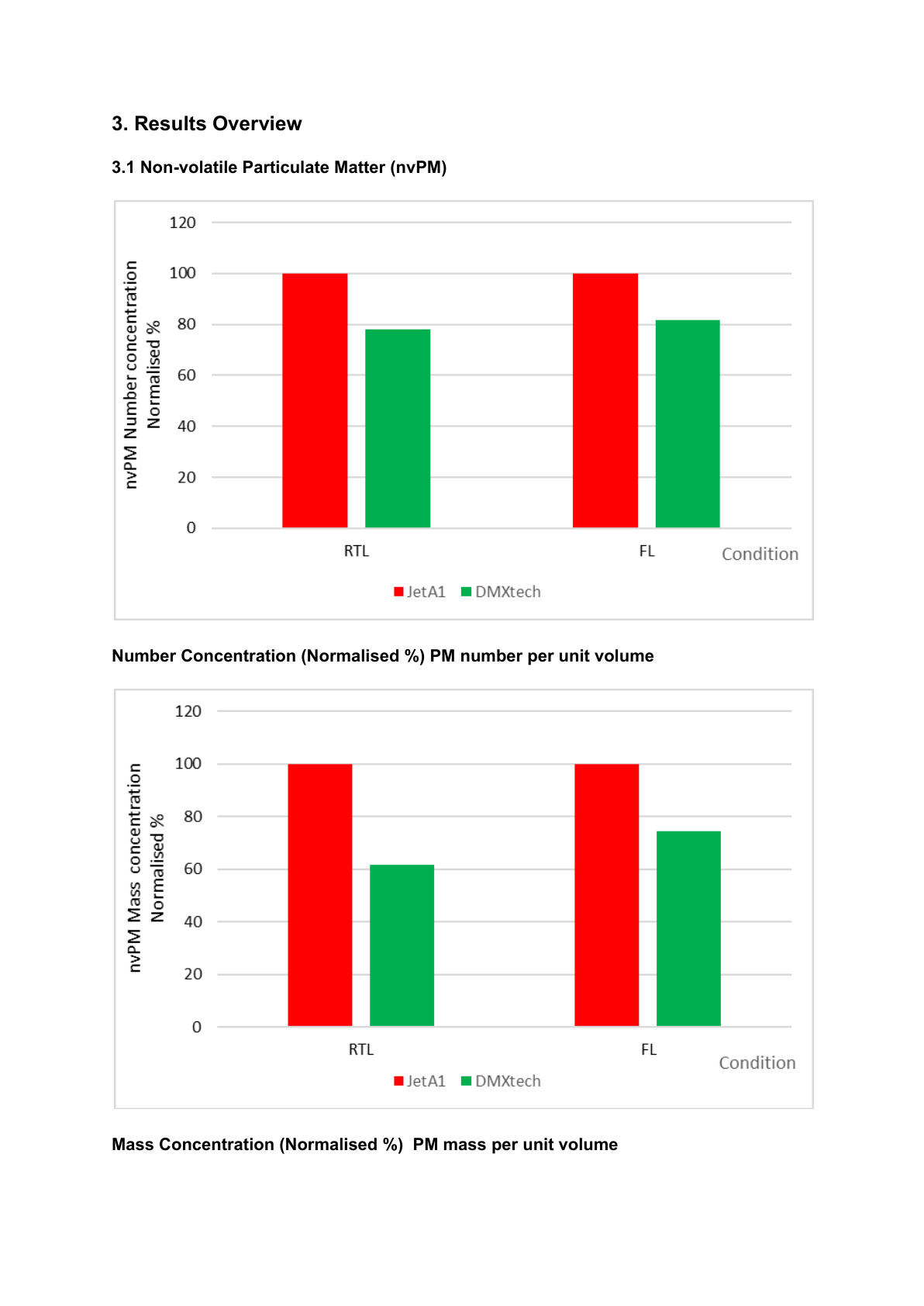
The TERC test report includes normalized nvPM number and mass comparisons against a Jet A‑1 baseline, measured at two operating conditions (RTL and Full Load). The plots show lower normalized nvPM for the DM‑XTech tLCAF sample under both conditions (see figure below).
Why this matters (MRV-aware)
- nvPM is one of the measurable emissions that is commonly used as a proxy for soot/particulate formation risk and is often discussed in the context of non‑CO₂ climate effects.
- EU non‑CO₂ MRV frameworks rely on models and default values; when accepted by the operator and verifier, providing higher‑quality primary inputs can improve precision relative to generic defaults.
- This page stays within “inputs not outcomes”: we show what was measured; the operator decides how it is used in reporting and verification.
Scope boundaries
- This is a ground test on an APU test platform — it is not a flight trial and does not, by itself, quantify contrail/route‑level climate impact.
- Any “CO₂e” or lifecycle claims require separate, scheme‑specific evidence (LCA, chain‑of‑custody, and applicable program rules).
- All statements are batch‑ and test‑context specific.
Gaseous emissions: summary table (reported values)
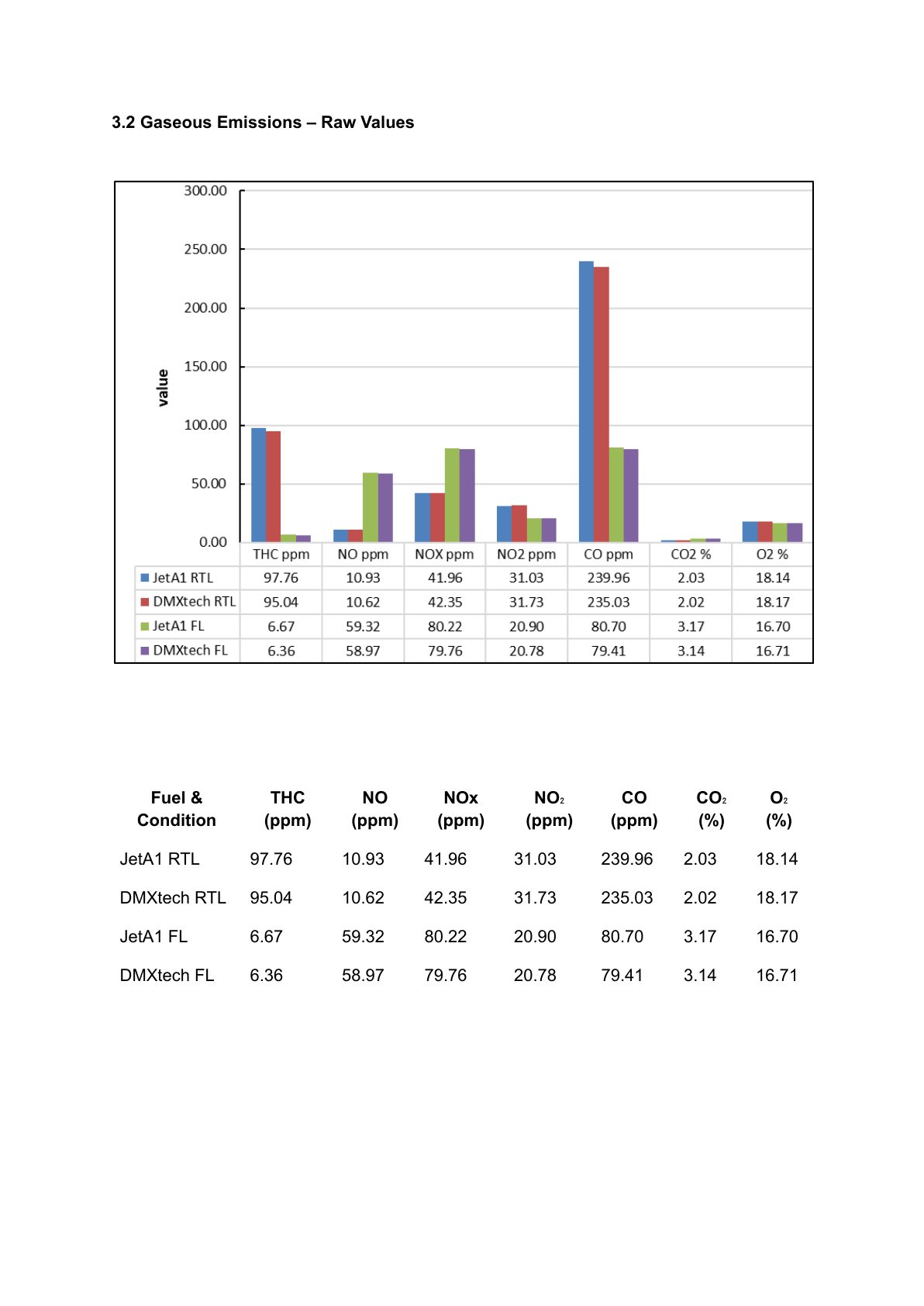
Reported stack gas measurements during the same test campaign (RTL and Full Load). Values are shown as recorded in the report.
| Condition | O₂ (%) | CO₂ (%) | CO (ppm) | NOx (ppm) | SO₂ (ppm) |
|---|---|---|---|---|---|
| Jet A‑1 — RTL | 18.44 | 2.18 | 66.64 | 17.59 | 0.28 |
| Jet A‑1 — Full Load | 15.89 | 4.58 | 3.84 | 106.40 | 0.34 |
| DM‑XTech tLCAF — RTL | 18.42 | 2.21 | 60.57 | 17.91 | 0.29 |
| DM‑XTech tLCAF — Full Load | 15.71 | 4.69 | 2.35 | 104.67 | 0.28 |
Fuel fingerprint: low aromatics (FIA) and density
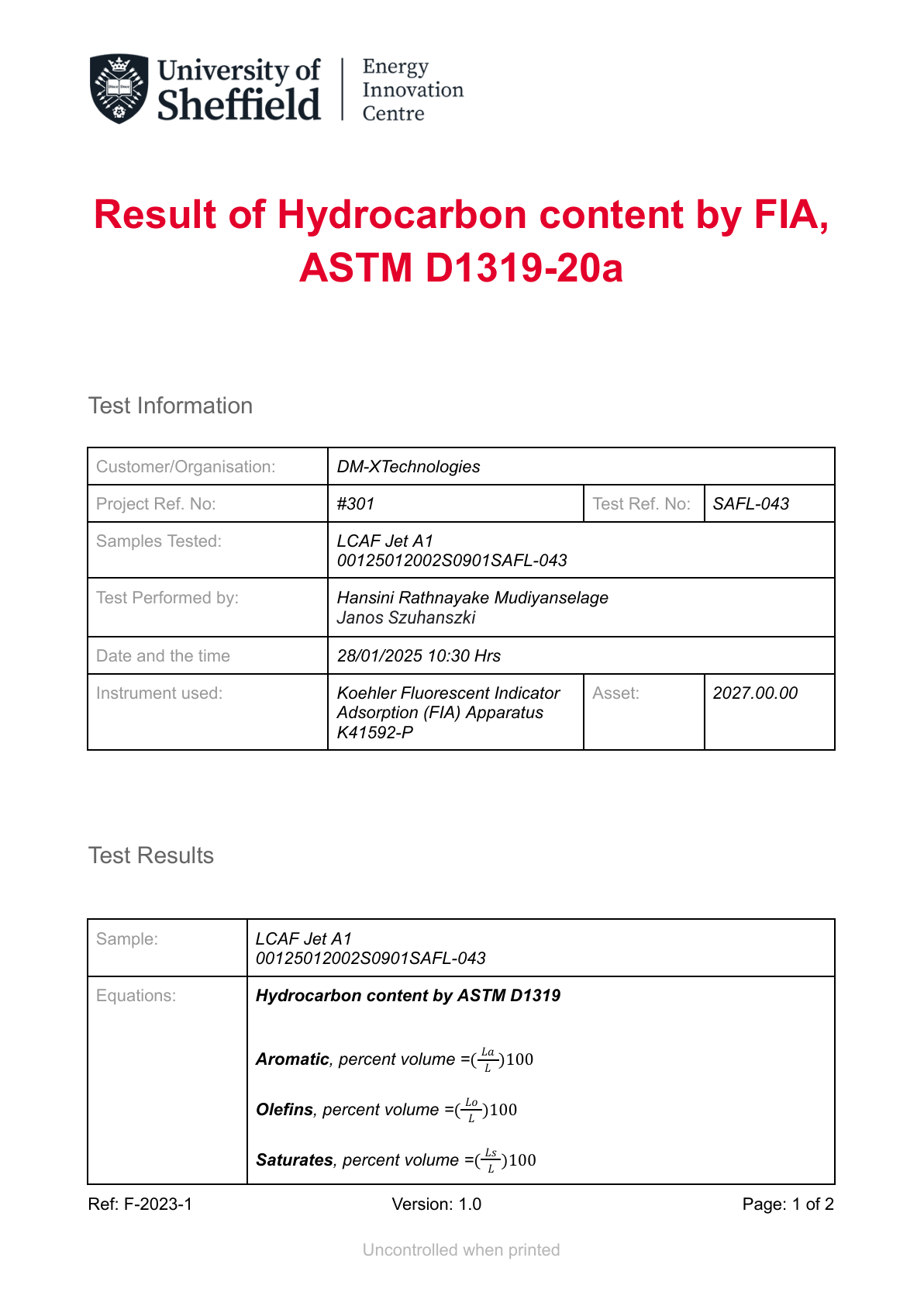
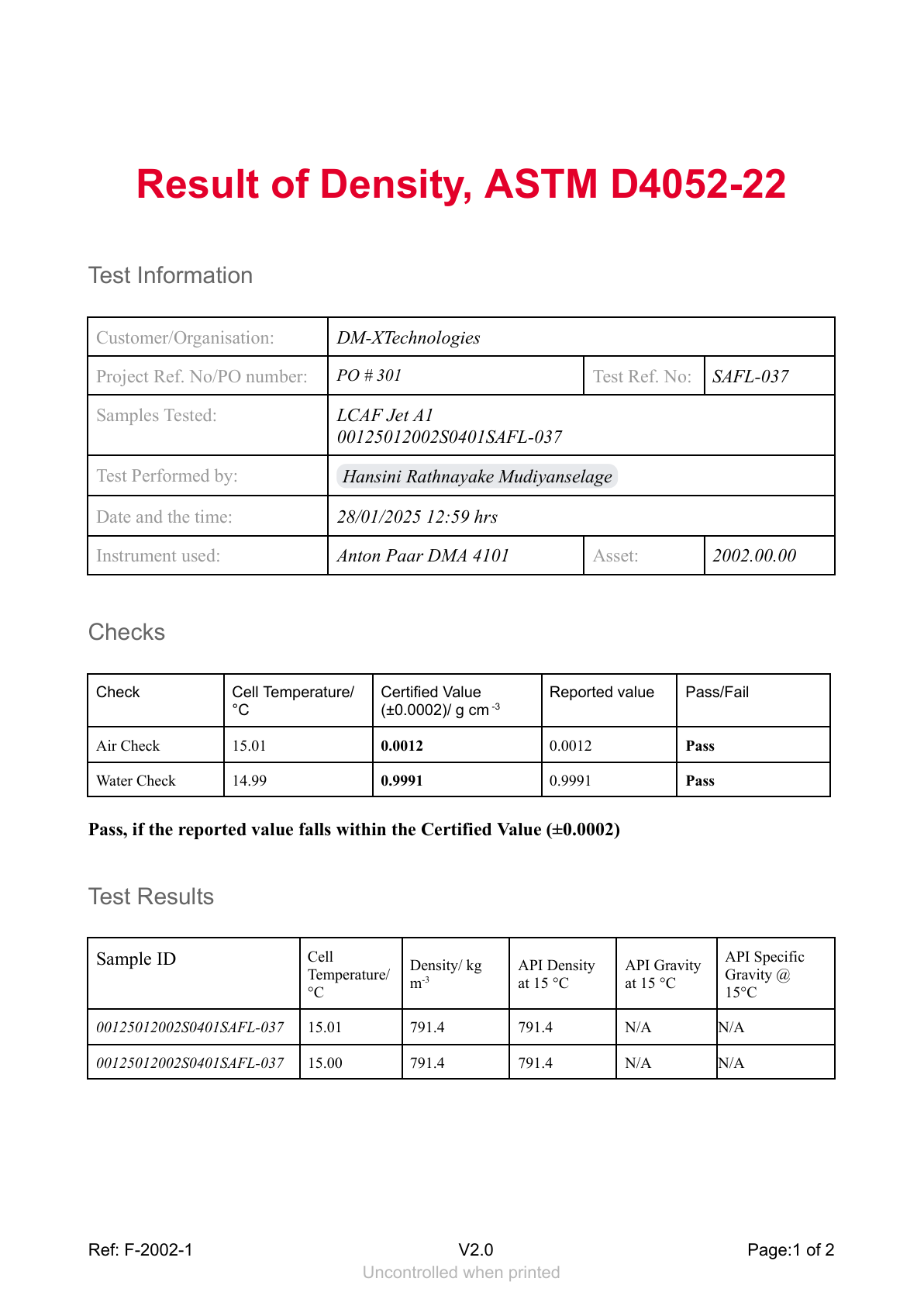
The report includes a fuel “fingerprint” via FIA and density. These values are useful for documenting batch‑level fuel properties that can be referenced in QA packs and MRV data discussions.
FIA (ASTM D1319) — % v/v
| Parameter | Result | Note |
|---|---|---|
| Aromatics | 8.5 | Reported value |
| Olefins | 0.6 | Reported value |
| Saturates | 90.9 | Reported value |
Note: the report flags that aromatic content below the method’s lower working range can increase uncertainty. Where necessary, confirm low‑aromatic levels using a method validated for that range.
Density @ 15°C
| Parameter | Result | Unit |
|---|---|---|
| Density | 791.4 | kg/m³ |
Trace elements (mg/kg)
| Element | Result |
|---|---|
| Ca | 0.037 |
| Cu | 0.007 |
| Fe | 0.008 |
| Na | 0.073 |
| Pb | 0.011 |
| Sn | 0.016 |
EU non‑CO₂ MRV: how this evidence is intended to be used
Under the EU’s non‑CO₂ MRV framework, aircraft operators monitor and report non‑CO₂ aviation effects per flight, using the Commission’s IT tool (NEATS) or other Commission‑approved tools, within the operator’s approved monitoring plan.
Evidence pack contents (what we can deliver at batch level)
- Batch CoA and fuel property sheet (including aromatic profile, density, and relevant QA parameters).
- Chain-of-custody / traceability documentation (production, storage, transfer, blending if any).
- Third‑party test report(s) relevant to nvPM and emissions (this page summarises one such report).
- Data room bundle structure for sharing with airline technical teams and independent verifiers.
Hard boundaries (what we do not claim)
- No statement that tLCAF “delivers compliance” or “ensures MRV acceptance.”
- No statement of guaranteed contrail reduction or route‑level climate impact without dedicated flight trials and modelling.
- No SAF, crediting, or lifecycle CO₂ claims unless separately evidenced and explicitly scoped.
Public references (for readers who want the primary sources)
- Commission Implementing Regulation (EU) 2024/2493 (EUR‑Lex)
- MRV non‑CO₂ Guidance for Aircraft Operators (European Commission, Feb 2025)
Disclaimer: This page is informational and is not legal or regulatory advice. Operators should consult their Competent Authority and accredited verifier.